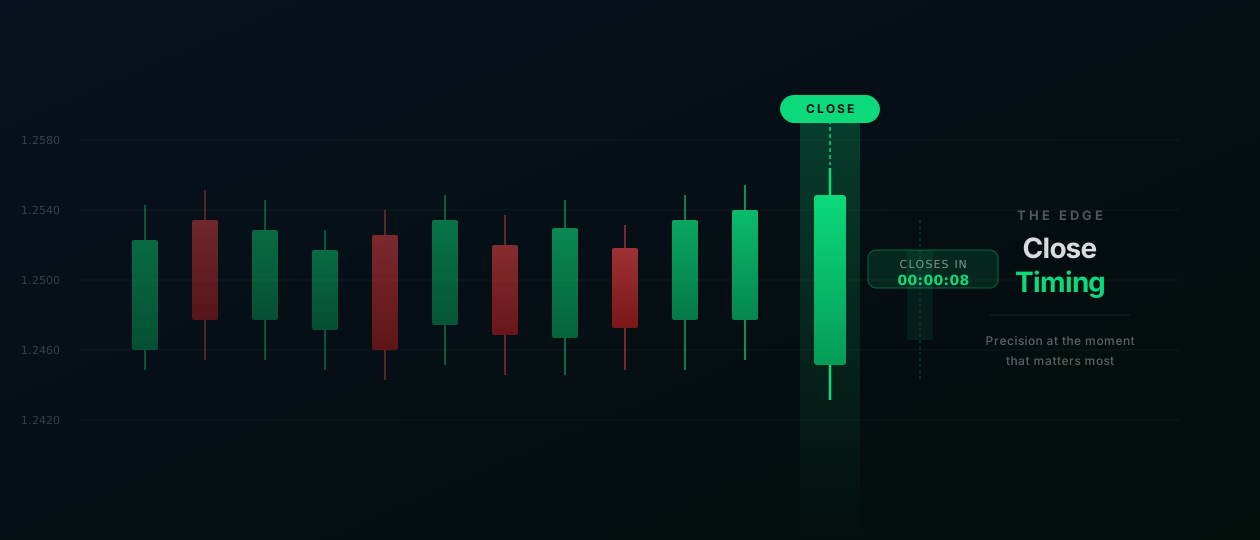
Every candle has four prices: open, high, low, and close. The close is the most important one, and most traders watch it with the least precision.
The reason is infrastructure. Your charting platform shows you the bar as it builds, but it rarely shows you how much time is left in it. You’re reading price action without knowing whether you’re looking at a candle with 50 minutes to go or 50 seconds. Those are completely different situations, and treating them the same is where imprecise timing costs you.
The Close Is a Vote, Not a Snapshot
A candlestick open or high can happen in an instant — a single aggressive order. The close is different. It’s where price is when the market runs out of time on that bar. Every participant who wanted to act in that timeframe has acted. The result is a consensus, constrained by the clock.
That consensus is the data. The body of the candle — the open-to-close range — tells you what the majority of that period’s activity agreed on. But you can only interpret it correctly if you know how the session into the close played out.
A bearish close that forms in the last 90 seconds of an H4 candle, after price spent most of the period ranging, means something different than a bearish close that printed at the 3-hour mark and held. The timer tells you which one you’re looking at.
How Knowing the Time Changes Your Read
On breakout trades: if price breaks a key level with 20 minutes left in an H4 candle, that’s a different signal than the same break with 3 minutes left. A late-candle break that holds the close is a confirmed signal; a break that reverts before close is a trap. Knowing the countdown tells you whether to act now or wait for the close to confirm.
On indecision patterns: a doji or spinning top mid-candle is noise. The same pattern as the bar approaches its close — when participants have had their full opportunity to drive price and couldn’t — is a genuine signal of indecision. Without the timer, they look the same.
On entries and exits: many clean setups require waiting for a candle to close before entering the next one. A timer removes the ambiguity of “is this candle done?” and lets you pre-position for the open of the next bar with a known countdown.
Why “Watching the Clock” Doesn’t Work
The traditional workaround is to keep a clock in view alongside your chart. This creates two problems.
First, it adds cognitive load at exactly the moment when you need focus. In the 60 seconds before an H4 close, you want to be reading price action, not doing arithmetic. Switching attention between chart and clock costs you the read.
Second, a clock alone doesn’t solve the alignment problem. H4 and daily candles close based on your broker’s server time, not UTC, not your local time. Without knowing your broker’s exact GMT offset and adjusting for it, a wall clock gives you the wrong answer.
BarClock handles both: the countdown runs on your phone, you set the GMT offset once, and the H4/D1 boundaries match your charts exactly. Your eyes stay on the chart.
Which Timeframes Reward Close Monitoring Most
Not every timeframe benefits equally from countdown tracking.
M1 and M5: candles form and close fast enough that individual closes matter less — the pace itself is the constraint. Most traders on these timeframes are watching flow, not close formation.
M15 and M30: the sweet spot for scalpers who care about session structure. Close watching here pays off on range breakouts and session-open setups.
H1: widely used for intraday trend traders. Knowing the close countdown helps distinguish a real reversal candle from an open that hasn’t had time to develop.
H4: the timeframe where close timing delivers the most edge for the most traders. Four hours is long enough for real signals to form, short enough for four to six close events per session to matter. This is BarClock’s home timeframe.
D1: for swing traders. The daily close is the most widely watched candle close in all of retail and institutional trading. Knowing it’s coming — with enough lead time to act — is simply good practice.
Track the timeframe you trade. The close tells you something. Make sure you’re there for it.